
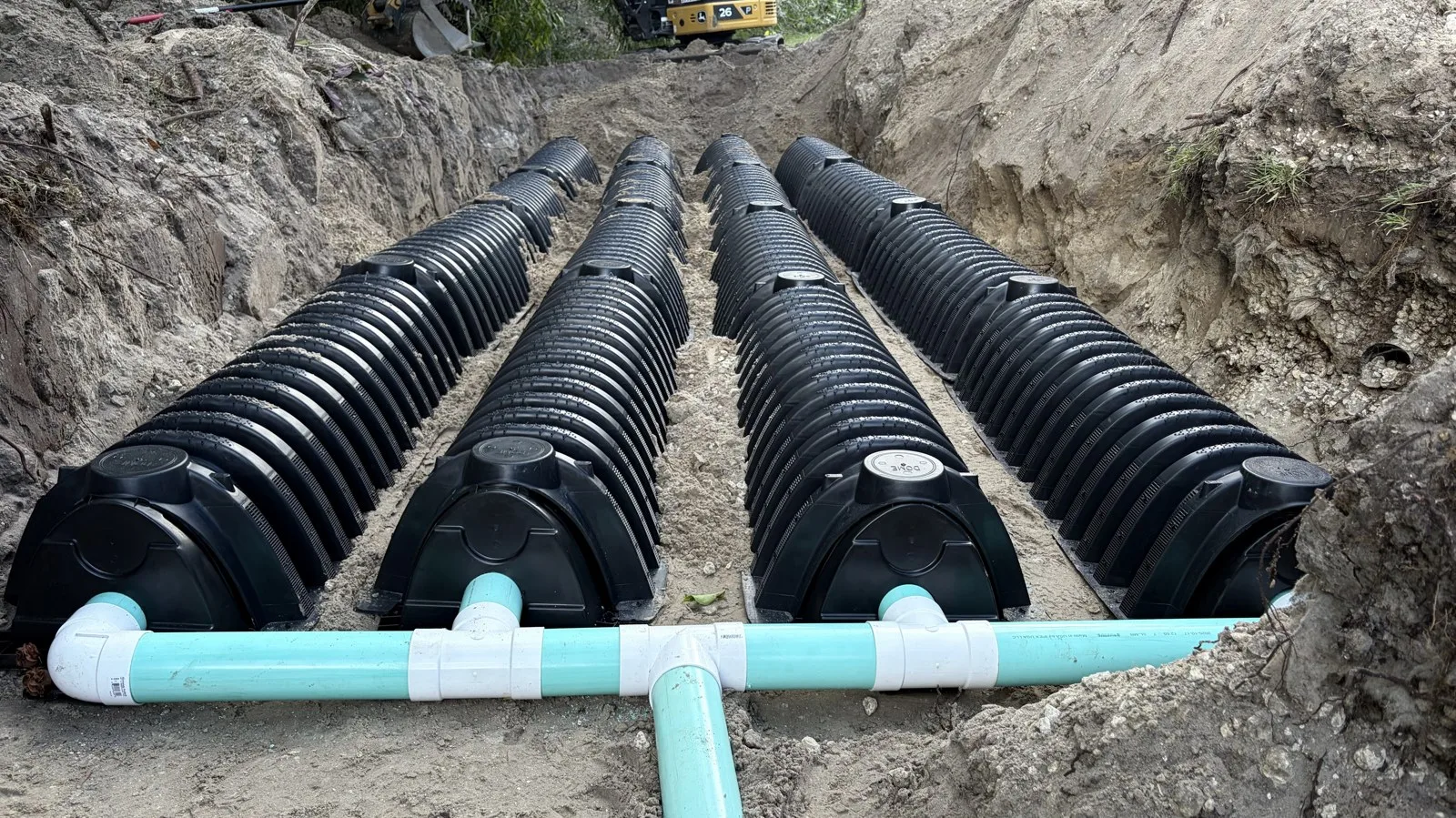
How much does a septic tank installation cost in Florida?
Most homeowners pay $3,593 to $12,463 for a new septic system, averaging $8,017, per HomeAdvisor in June 2026. This Old House put the March 2026 range at $3,480 to $11,625. Florida rules keep the drain field 24 inches above the wet season water table, so many lots need fill.
Those are national market ranges. The real number comes from the soil, the water table and the system your county approves. That is why our septic tank installation service prices every job after a site visit, for free.
What does a new septic system cost in 2026?
Three national guides land close together. HomeAdvisor, updated June 2026, gives $3,593 to $12,463 with an $8,017 average. This Old House, March 2026, gives $3,480 to $11,625 and says complex systems can pass $23,000. Today’s Homeowner, April 2025, gives $3,610 to $12,412. Florida-only figures are thin.
| What you are paying for | Typical range | Source |
|---|---|---|
| Full conventional system installed, tank plus drain field | $3,593 to $12,463 | HomeAdvisor, June 2026 |
| Same job, second read | $3,480 to $11,625 | This Old House, March 2026 |
| Septic tank only, by material | $500 to $2,500 | This Old House, March 2026 |
| Drain field installation | $5,000 to $12,000 | HomeAdvisor, June 2026 |
| Tank and drain field replaced together | $2,000 to $20,000 | Bob Vila, December 2023 |
| Mound or elevated fill system | $10,000 to $20,000 | HomeAdvisor, June 2026 |
| Aerobic treatment unit | $10,000 to $20,000 | This Old House, March 2026 |
| Engineered or alternative system | $5,000 to $18,000 | This Old House, March 2026 |
| Permits, design and site testing | $450 to $2,300 | HomeAdvisor, June 2026 |
Treat every line as a market range. Your lot sets the real number.
What drives the price of a septic installation?
Labor is the biggest line. This Old House puts it at 50 to 70 percent of the total, or $1,500 to $4,000. Bob Vila’s December 2023 figures put labor near 60 percent, around $3,600. Tank size, soil results, the water table and the permit path move the rest.
Tank size follows bedroom count. A 1,000-gallon tank, the usual size for 3 to 4 bedrooms, runs $900 to $1,500 in HomeAdvisor’s June 2026 breakdown. Material shifts it again: This Old House prices concrete at $700 to $2,000 and plastic at $500 to $2,500. Those are tank prices, not installed prices.
The ground carries its own cost. Bob Vila prices excavation at $1 to $5 per square foot and tree and root removal at $200 to $2,000.
What makes a South Florida installation different?
Water. Florida Administrative Code Rule 62-6.006 keeps the wet season water table at least 24 inches below the bottom of the drain field. The rule also asks for 42 inches of effective soil depth under the field. On flat, sandy lots near canals, that often means trucking in fill or raising the field.
The rule allows for that. Where a site does not meet the depth on its own, fill can be brought in so the system is built at the final lot elevation. University of Florida IFAS Extension explains why: treatment happens in unsaturated soil, and waterlogged soil hinders the removal of pollutants.
When fill is not enough, the design changes. The EPA lists mound systems as an option where soil is shallow or groundwater is high, and both HomeAdvisor and This Old House price them at $10,000 to $20,000. Aerobic treatment units sit in that same band, against $3,000 to $8,000 for a conventional anaerobic system. Our page on drain field installation and replacement covers what goes in the ground after the tank.
What do the permits cost in Broward, Palm Beach and Miami-Dade?
Broward County publishes its numbers. Its health department charges $100 for plan review and $260 for the permit, a fee that covers two inspections. A site evaluation by department staff adds $165. Palm Beach County and Miami-Dade County permit through their own health department offices, so the fee comes from the county your property sits in.
Florida’s septic program moved to the Florida Department of Environmental Protection on July 1, 2021, under the Clean Waterways Act. County health department offices still run the permitting and the inspections.
The application is where the site work starts. A new system permit needs an application form, a site plan, a building floor plan and a site evaluation of the soil. Broward’s packet also asks for two soil profiles to a minimum depth of 72 inches, plus a sealed survey by a licensed surveyor. Florida Statute 381.0066 caps what a county can charge for review, permitting and site evaluation. Our guide to Florida septic rules and permits covers those offices in more detail.
Does Florida require a nitrogen-reducing system?
Sometimes. Effective July 1, 2023, HB 1379 changed what goes in the ground on small lots. New systems on lots of one acre or less in Basin Management Action Plan and Alternative Restoration Plan areas must be nitrogen-reducing rather than conventional, when sewer is not available. These systems meet at least 65 percent nitrogen reduction.
Three types are approved for that standard: in-ground nitrogen-reducing biofilters, Florida-approved NSF 245 certified aerobic treatment units, and Florida-approved nitrogen-reducing performance-based treatment systems. Ten Florida counties contain no impacted areas at all, and Broward, Palm Beach and Miami-Dade are not among them. FDEP’s mapping tool settles whether one address is inside.
No cost guide publishes a Florida price for these systems. Two of the three approved types sit in the $10,000 to $20,000 and $5,000 to $18,000 bands above.
Is a replacement cheaper than a new system?
Usually, if the drain field survives. HomeAdvisor’s June 2026 guide puts a tank swap without a new field at $3,000 to $10,000, and drain field replacement on its own around $7,000. Bob Vila’s December 2023 figures put a tank and field replaced together at $6,000 on average, in a $2,000 to $20,000 range. Our guide to drain field replacement costs in South Florida breaks the field side down.
Age tells you which one you are looking at. Most systems last 15 to 40 years, and HomeAdvisor puts the tank alone at 15 to 20. Onsite Installer reported in June 2024 that concrete tanks can pass 40 years, while steel corrodes out at 15 to 20. Drain fields average about 20 years.
Pulling the old tank is billed by the hour, $45 to $200, per Today’s Homeowner in April 2025. If the field is sound and only the tank has failed, a new septic tank installation is the smaller job. If the field is the problem, HomeAdvisor’s June 2026 repair guide puts that at up to $20,000. A pump-out and a look inside the open tank answer the question, and our post on septic pumping prices in South Florida covers that visit.
How long does a septic system installation take?
The digging is the short part. Today’s Homeowner, April 2025, puts the installation itself at five to seven days. The full process, from soil testing through inspections, can run up to eight weeks. Broward’s permit fee covers two inspections, so the calendar belongs to the county as much as to us.
Palm Beach County adds a step. The septic plan has to be approved before a building permit is issued, and the final inspection has to be recorded before a certificate of occupancy.
What changes the number on your lot?
Two houses on the same block can price differently, and the reasons are physical. The items below come out of the cost guides and the Broward County application packet. Each one moves the total, some by a few hundred dollars and some by thousands.
- Bedroom count, which sets tank size: a 1,000-gallon tank covers 3 to 4 bedrooms
- Soil and percolation results, tested at $700 to $2,000
- How far the wet season water table sits below the field, and how much fill the lot needs
- System type: conventional, aerobic, or an engineered design the county approves
- Excavation and trenching, at $1,500 to $6,000
- Distance from the house to the tank, at $50 to $150 per linear foot of new line
- Removing and hauling the old tank, at $45 to $200 per hour
- Parts added at the end: a distribution box at $500 to $1,500, a riser at $300 to $600
Get a real number for your property
A price for your address needs the bedroom count, the lot, the soil and the system your county will permit. We look at the property and handle the county health department paperwork. You get the number before any work starts, and quotes are free. Call (954) 350-2046 or use the contact page, any hour, across Broward, Palm Beach and Miami-Dade.