
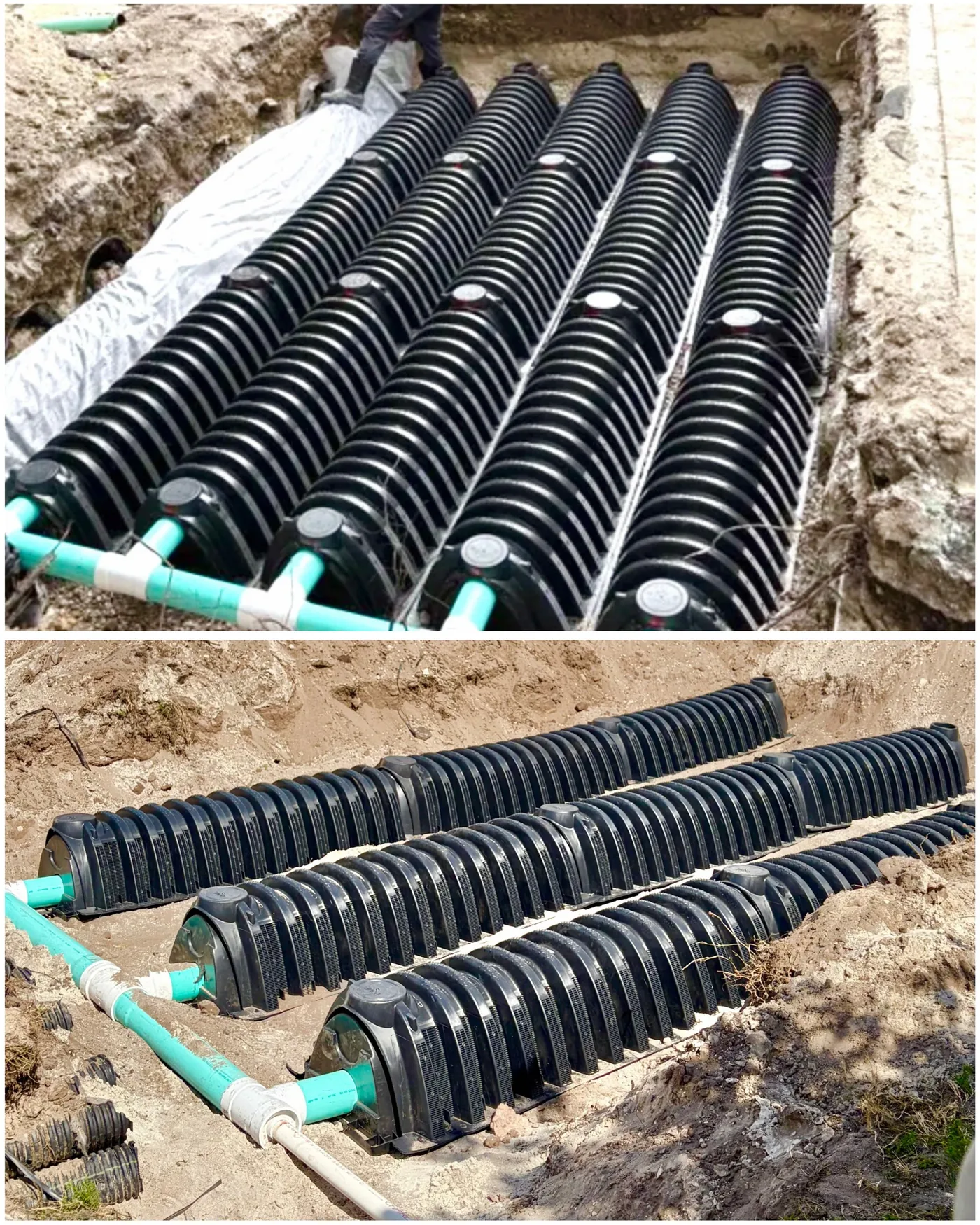
How much does a drain field replacement cost in South Florida?
A new drain field runs $5,000 to $12,000 in HomeAdvisor’s June 2026 guide, which puts a straight replacement at around $7,000. Fixr, in January 2025, spans $2,000 to $20,000. Florida keeps the bottom of the field 24 inches above the wet season water table, which is what pushes South Florida jobs higher.
Those are national market ranges. What your yard costs depends on the soil, the water table and the size the county requires, which is why our drain field installation and replacement work gets priced after a site visit, for free.
What does a drain field replacement cost in 2026?
Four guides put the job in the same neighborhood. HomeAdvisor, June 2026, installs a field for $5,000 to $12,000 and replaces one for around $7,000. Modernize, August 2026, says $6,000 to $7,000. Fixr, January 2025, stretches from $2,000 to $20,000, because one job is a trench swap and another is a rebuilt system.
| What you are paying for | Typical range | Source |
|---|---|---|
| Drain field installation, national | $5,000 to $12,000 | HomeAdvisor, June 2026 |
| Drain field replacement, second read | $6,000 to $7,000 | Modernize, August 2026 |
| Drain field replacement, full market range | $2,000 to $20,000 | Fixr, January 2025 |
| Tank and drain field replaced together | $2,000 to $20,000 | Bob Vila, December 2023 |
| Field repair or rejuvenation instead of replacement | $1,000 to $5,000 | Fixr, January 2025 |
| Field priced by system type, anaerobic up to mound | $5,000 to $12,000 | Today’s Homeowner, April 2025 |
| Mound or elevated fill system | $10,000 to $20,000 | HomeAdvisor, June 2026 |
| Permits on the building side | $450 to $2,300 | HomeAdvisor, June 2026 |
Treat every line as a market range. Bob Vila’s December 2023 figures put labor at about 60 percent of the price, near $3,600, so access and depth move the total.
Can a drain field be repaired instead of replaced?
Sometimes, and Florida draws that line in writing. Fixr, January 2025, prices leach field rejuvenation and field repair at $1,000 to $5,000 each. But Rule 62-6.015 of the Florida Administrative Code says that where the absorption surface sits within 6 inches of the wet season high water table, an alternative repair method cannot be used.
FDEP describes an alternative repair method as a way to repair a failing system without drain field addition or replacement, and keeps a list of the methods it has accepted, from air addition systems to physical disruption of the soil beside the field. It also states that accepting a method is not an endorsement of its effectiveness.
The other half of the question is whether the field is even the problem. A broken baffle, a cracked lid or a clogged outlet can flood a yard while the field underneath is fine. HomeAdvisor’s June 2026 repair guide prices a baffle at $300 to $900, a tank lid at $150 to $500 and a cracked lateral line at $1,500 to $5,000, so a septic tank repair is the cheaper answer when the tank failed. A pump-out and a look inside the open tank tells the two apart.
What makes a South Florida drain field cost more?
Water. Florida Administrative Code Rule 62-6.006 requires the wet season water table to sit at least 24 inches below the bottom surface of the drain field, with 42 inches of effective soil depth under it. On flat, sandy lots near canals, that often means trucking in fill or building the field up.
The rule allows for that. Where a site cannot meet the depth on its own, fill can be placed on the property so the system is built at the final lot elevation. University of Florida IFAS Extension explains why: treatment happens in unsaturated soil.
When fill is not enough, the design changes and the price follows it. HomeAdvisor’s June 2026 guide puts a mound system, which uses an elevated sand mound instead of excavating into the soil, at $10,000 to $20,000. Today’s Homeowner, April 2025, prices the field by the system it serves: anaerobic $5,000, aerobic $7,000, evapotranspiration $8,000, mound $12,000. Our guide to what a whole new septic system costs in Florida covers the tank side of that math.
The groundwater here is measured, not guessed at. Miami-Dade County reports approximately 120,000 septic systems in use, about 9,000 of them vulnerable under current conditions and approximately 13,500 by 2040. In South Florida the groundwater sits close to the surface, and closer still in the wet season.
What do the permits look like in Broward, Palm Beach and Miami-Dade?
Broward County publishes its repair numbers: $210 for a standard system repair permit, $260 for a filled or mound system, and $140 if department staff perform the site evaluation. Palm Beach County and Miami-Dade County permit through their own health department offices, so the fee follows the county your property sits in.
Rule 62-6.015 sets the bar for all of them. Repairs to a failing system are made only with prior knowledge and written approval from the Department, and the amount of drain field installed during a repair cannot be less than what the system had before. Florida’s septic program moved to the Florida Department of Environmental Protection on July 1, 2021, and county health department offices still run the permitting and inspections.
The paperwork is where the site work starts. Broward’s repair packet asks for the application, a site plan, a repair evaluation of the existing system, and two soil profiles to a minimum depth of 6 feet or refusal in the absorption area. It also wants unobstructed reserve ground at least 1.5 times the size of the field, contiguous to it, which is why a tight lot costs more than a roomy one.
Palm Beach County adds a sequence: septic plans have to be approved before a building permit is issued. Nitrogen-reducing rules are a separate question. Florida’s HB 1379 requirement attaches to new system construction permits on lots of one acre or less inside impacted areas, and FDEP notes that other situations pull in new system standards too, so the county office decides which permit your job falls under. Our post on Florida septic rules and permits covers those offices.
How long should a drain field last?
Bob Vila’s December 2023 guide puts the average septic drain field at 20 years. HomeAdvisor’s June 2026 repair guide gives a range of 15 to 25 years. What pulls a field to the short end is what reaches it: solids from a tank that never gets pumped, grease, roots and compacted soil over the lines.
The EPA’s list of what damages a field is short and physical. Vehicles and heavy equipment compact the soil and can damage pipes. Roof drains and sump pumps aimed at the field add water that slows down or stops treatment. Concrete and asphalt over the lines cut off the oxygen the bacteria need.
Pumping is the cheap end of that math. A tank on a schedule sends water to the field and keeps the sludge behind, and our guide to septic pumping prices in South Florida puts that service next to a five-figure field job.
What changes the number on your lot?
Two houses on the same street can price differently, and the reasons are physical. Each item below comes out of the cost guides or the Broward County repair packet. Some move the total by a few hundred dollars, and two or three of them are the difference between a repair and a five-figure rebuild.
- Whether the field can be repaired or has to come out, a $1,000 to $5,000 job against a $5,000 to $12,000 one
- How far the wet season water table sits below the field, and how much fill the lot needs
- System type: a conventional field, a chambered system, or a mound at $10,000 to $20,000
- Field size, which follows the bedroom count and the soil, and cannot shrink below what the old system had
- Reserve ground, since the county wants unobstructed area 1.5 times the field, contiguous to it
- Access for equipment, and how far the trench sits from where a truck can work
- Excavation, at $1 to $5 per square foot per Bob Vila in December 2023
- Permits and soil testing, at $450 to $2,300 for permits and around $1,000 for a percolation test
- Restoring the yard once the lines are covered
Get a real number for your drain field
A price for your address needs the soil, the water table, the size the county requires, and a look at whether the tank or the field failed. County health department paperwork is part of a new drain field. Quotes are free. Call (954) 350-2046 or use the quote form, any hour, across Broward, Palm Beach and Miami-Dade.