
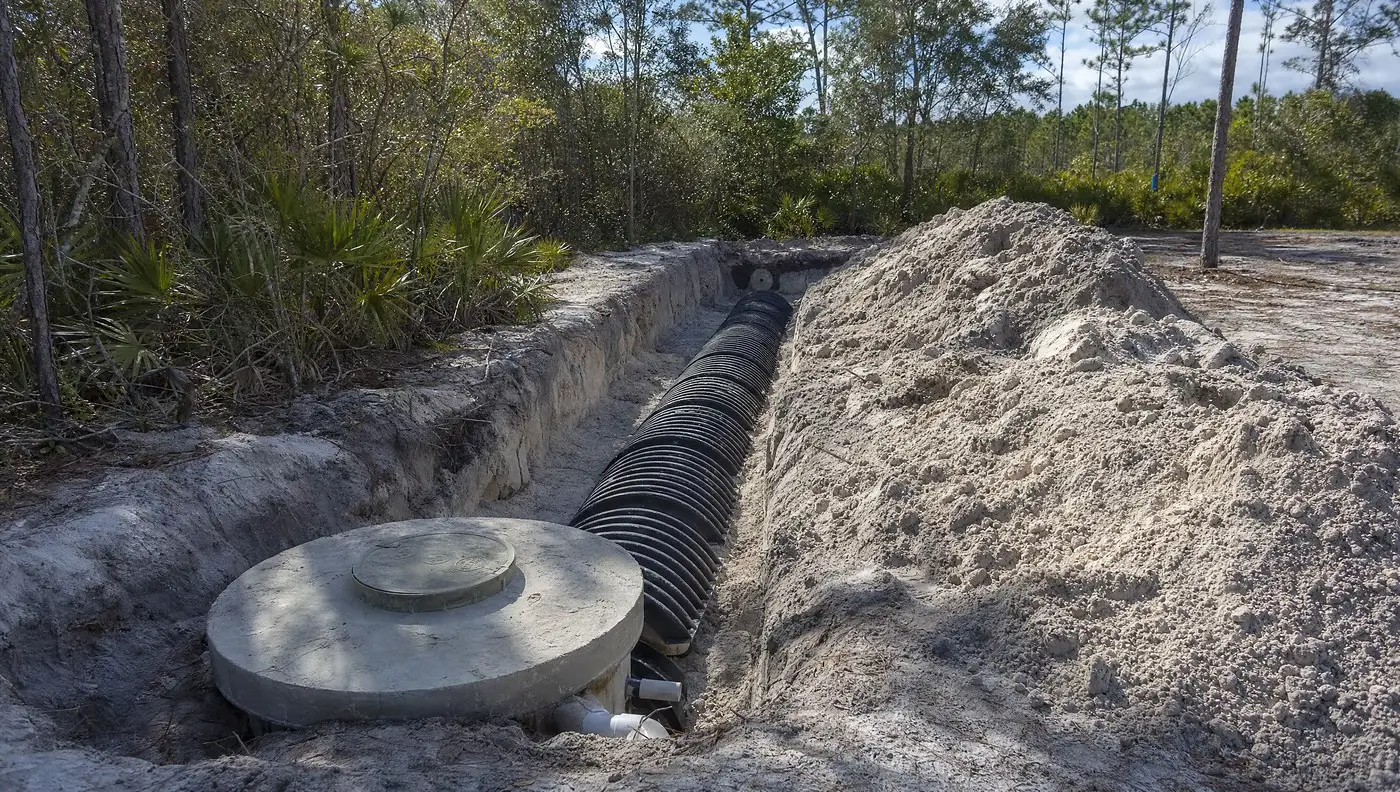
Concrete vs plastic septic tank in Florida: which is better?
Neither wins everywhere. Florida allows concrete, fiberglass and polyethylene tanks, and each model needs state approval. HomeAdvisor’s June 2026 guide puts a concrete tank at $700 to $2,000, tank only. A plastic one runs $500 to $2,000. Onsite Installer puts concrete past 40 years and plastic at 20 to 30. Access, groundwater and budget decide the rest.
Those are national market ranges for the tank alone. On a real lot, truck access and groundwater drive the choice, and the county permit settles it. For septic tank installation in South Florida, we price the job after a site visit, and the quote is free.
What septic tank materials does Florida allow?
Florida allows three: concrete, fiberglass and polyethylene, under Rule 62-6.013. Every tank model must be approved by the state before it is offered for sale or installed. The Florida Department of Environmental Protection (FDEP) lists its approved septic tank designs on its product listings page. A tank that is not an approved design cannot go in the ground.
The rule sets a floor for each material. A concrete tank needs a 28-day compressive strength of at least 4,000 psi. At least 30 percent of a fiberglass tank’s weight must be fiberglass reinforcement. A polyethylene tank must meet a national standard from the International Association of Plumbing and Mechanical Officials.
The rule also writes wet ground into the design. Its two tank design classes must both be designed for saturated soil, with the saturation at finished grade. In plain terms, the design assumes soil soaked all the way to the surface.
How do concrete, plastic and fiberglass septic tanks compare?
Concrete is the heavy, long-lived option, and plastic is the light one that starts cheapest. Fiberglass is light too, and it starts highest as a bare tank. The table lines up the sourced numbers, and each material has its own weak spot.
| What you are comparing | Concrete | Plastic (polyethylene) | Fiberglass | Source |
|---|---|---|---|---|
| Tank only | $700 to $2,000 | $500 to $2,000 | $1,200 to $2,000 | HomeAdvisor, June 2026 |
| How long it can last | over 40 years, up to 100 | 20 to 30 years | 20 to 30 years | Onsite Installer, June 2024 |
| Delivery and setting | needs a special truck | ordinary pickup, set with a backhoe | ordinary pickup, set with a backhoe | Kansas health department guide |
| Repair range | $700 to $5,000 | $150 to $2,000 | $750 to $7,500 | HomeAdvisor, June 2026 |
| Weak spot | may crack over time | can be damaged during installation | can shift in the soil | HomeAdvisor, June 2026 |
Treat the price and repair rows as national market ranges.
How much does each septic tank material cost in 2026?
Tank only, three national guides land close together: concrete at $700 to $2,000 and fiberglass at $1,200 to $2,000. Plastic starts lowest at $500, and its top end runs $2,000 to $2,500 depending on the guide. Installed is a different number, because the tank is only part of the job.
| What you are paying for | Typical range | Source |
|---|---|---|
| Concrete tank, tank only | $700 to $2,000 | This Old House, March 2026; Today’s Homeowner, April 2025 |
| Plastic tank, tank only | $500 to $2,500 | This Old House, March 2026 |
| Fiberglass tank, tank only | $1,200 to $2,000 | This Old House, March 2026; Today’s Homeowner, April 2025 |
| Replacement tank installed, drain field kept | $3,000 to $10,000 | HomeAdvisor, June 2026 |
| Septic system installed, typical range | $3,480 to $11,625 | This Old House, March 2026 |
This Old House’s March 2026 numbers show the scale: a tank of any material runs $500 to $2,500, and a typical installed septic system $3,480 to $11,625. HomeAdvisor adds that a swap costs less than a new system, since excavation is already done. Our Florida septic tank installation cost guide breaks down the rest of the bill.
Which tank is easier to get into a South Florida yard?
Plastic and fiberglass. The Kansas health department’s septic guide says concrete tanks are very heavy and need special trucks to deliver and set. Plastic and fiberglass tanks are light enough for an ordinary pickup, and a backhoe can set them. That matters when a pool cage or a narrow side yard blocks the truck.
The same guide calls light tanks life-savers where a heavy truck cannot reach the spot. A concrete tank that is struck or dropped may crack, and a cracked tank must be rejected. On the plus side, This Old House says concrete’s weight helps keep it stable underground.
Can a plastic septic tank float in South Florida?
It can, and so can any empty tank sitting in groundwater. The Kansas health department guide says tanks in a water table tend to float, especially right after pumping. One poly tank maker warns that pumping out during a high water table risks floating or distortion at the base.
That warning matters more here. Miami-Dade County says South Florida’s groundwater is just a few feet beneath the surface. It usually comes closest at the end of the wet season, around September and October. In the dry season it may sit a foot or two lower.
Light tanks need more care in that water. Set against the maker’s instructions, a plastic tank can end up tilted, deformed or floating, per the Kansas guide. The guide also says not to empty a tank completely when groundwater sits well above its bottom. It advises refilling the tank right after service. If your tank is plastic or fiberglass, mention it when you book septic tank pumping.
How long does a concrete septic tank last compared with plastic?
Onsite Installer reported in June 2024 that concrete tanks can last over 40 years, potentially up to 100. Plastic and fiberglass tanks offer a solid 20 to 30 years. HomeAdvisor’s June 2026 guide is more conservative for tanks in general: 15 to 20 years, depending on materials, maintenance and soil.
Concrete wears from the inside. Hydrogen sulfide gas mixes with moisture above the liquid line. That forms sulfuric acid, which eats at the concrete, per the Kansas guide.
We check the tank’s condition while it is open during a pump-out. That is when a crack or a deformed wall is easiest to see. Our guide to what septic tank repairs cost in Florida prices the common fixes.
Where does fiberglass fit?
Fiberglass sits between the other two. It is light like plastic, so a backhoe can set it. HomeAdvisor calls it strong and says it won’t crack, but notes it can shift in the soil. This Old House says it may need anchoring where groundwater runs high. As a bare tank, it starts highest, at $1,200 to $2,000.
What do Broward, Palm Beach and Miami-Dade require?
A county health department permit, whatever the material. FDEP permits septic systems itself only in Northwest Florida and Marion County. In Broward, Palm Beach and Miami-Dade, the county health department office handles it. In Palm Beach County, that office is charged with regulating, permitting and monitoring onsite sewage systems.
The paperwork tracks material. Broward’s repair permit packet records the existing tank’s material as concrete, fiberglass or polyethylene. Size is a separate rule, and our guide to how big a septic tank Florida requires has the chart.
Groundwater is a county-level issue here. Miami-Dade County has identified approximately 120,000 septic systems in use. About 9,000 were found vulnerable under current conditions. Our guide to Florida septic rules and permits covers each county office.
Which septic tank is better for a South Florida lot?
It depends on the lot, and the county permit and its site evaluation have the final say. A tight yard favors a light tank that a backhoe can set. A high water table favors weight, or a light tank set by the maker’s instructions and pumped with care. On price alone, plastic starts lowest as a bare tank.
What changes the answer on your lot:
- How close a heavy delivery truck can get to the tank spot
- How near the surface groundwater comes at the end of the wet season
- Whether the job is a tank swap with the drain field kept, or a full new system
- What repairs could cost later: $150 to $2,000 for plastic, $750 to $7,500 for fiberglass
We are a licensed septic tank and drain field installation specialist. On a new or replacement septic tank, the site and the permit shape the material choice.
Get a real number for your tank
A tank choice needs the lot in front of us. Tell us the city and whether the job is new or a swap. We price it after a site visit, and the quote is free. Call (954) 350-2046 or use the quote form, any hour, across Broward, Palm Beach and Miami-Dade.